Mercer County Court Records After a Jail Arrest
After a Mercer County arrest, the practical sequence is arrest, booking, bond or first appearance, prosecutor review, formal charge filing, court hearings, disposition, and possible sentencing, probation, or Missouri Department of Corrections transfer. The local charging office is the Mercer County Prosecuting Attorney, not a district attorney. Missouri DPS lists that office at 802 E. Main, Princeton, MO 64673, with phone 660-748-3332 and fax 660-748-4704. The current prosecutor name was not found in official sources, so it should not be assumed from older directories or third-party pages.
The court side is separate from the jail side. A Mercer County jail note may reflect an arrest allegation, a warrant hold, or a booking description entered at intake. Formal court records after an arrest come from the filed criminal or traffic case in the Mercer County Circuit Court and Missouri Case.net. For custody status, booking fields, release, or transfer details, use jail inmate records. For booking-photo availability and request limits, use jail mugshots. The authoritative legal outcome is the court disposition, not the original jail charge label.
How to Find Mercer County Court Records After an Arrest
Missouri Case.net is the official statewide court portal for public case records. Automated access to the portal can be blocked, but the portal remains the correct public starting point for Mercer County court records after an arrest. If the case number is unknown, search by litigant name, then narrow by county or court when the option is available. The Mercer County Circuit Clerk-Recorder is the local clerk contact for court files and is listed at 802 E. Main, Princeton, MO 64673-1240, phone 660-748-4335.
- Open Missouri Case.net, the official court-search entry point.
- Choose a litigant or name search when the case number is unknown, then enter the defendant's last name and first name.
- Narrow to Mercer County, the 3rd Judicial Circuit, or the appropriate court filter when the portal provides that option.
- Open the criminal or traffic case and review the case number, charge list, docket entries, warrants, bond entries, scheduled hearings, and disposition.
- Contact the Mercer County Circuit Clerk-Recorder if the online case is older, incomplete, sealed, or unclear.
For the statewide court-search starting point, use the official Missouri Case.net portal.
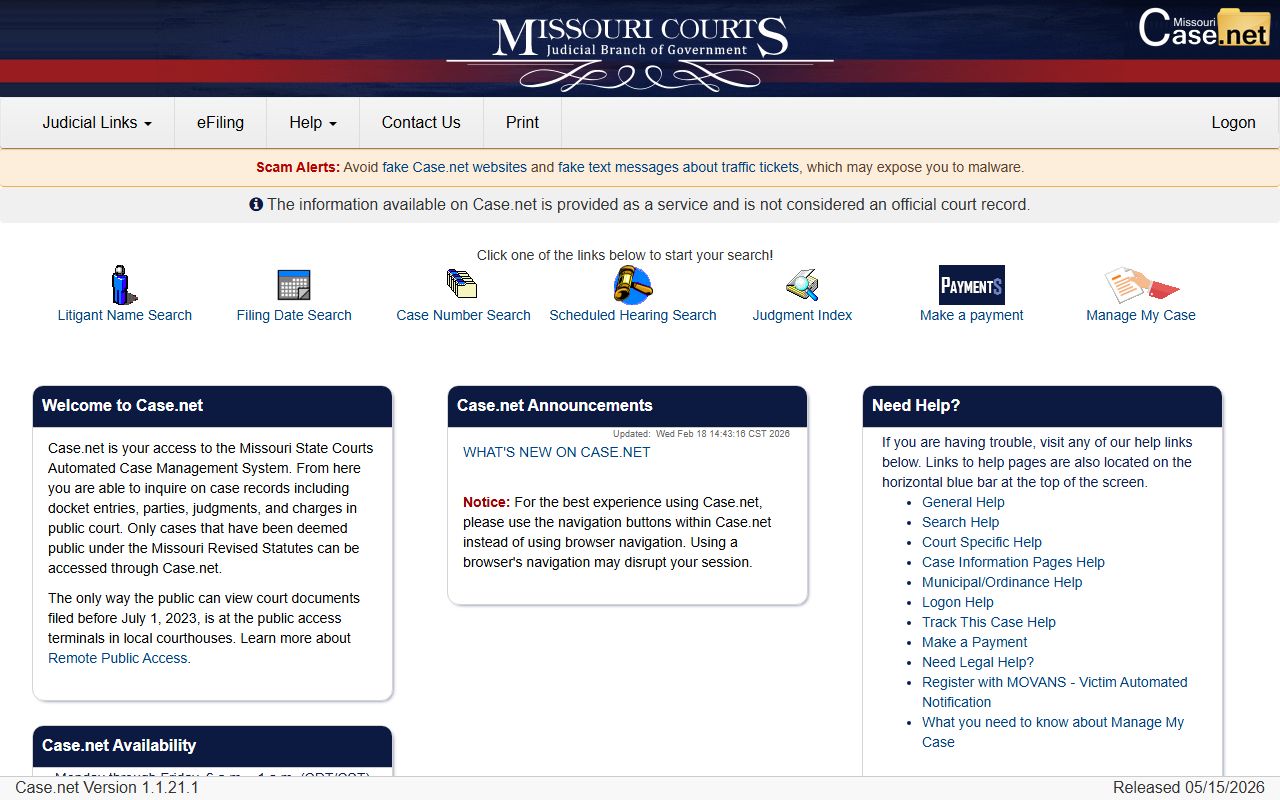
Case.net should be read as the court case record, not as a live jail roster. A defendant may have a case record even after release from Mercer County Jail, and a person may also appear in a jail record before the final court charge list is filed or amended.
| Case.net Field | Type | Required | How to Use It |
|---|---|---|---|
| Case Number | Text | Optional | Best when known because it points to a specific court file. |
| Litigant Name | Text | Optional | Use the defendant's name when the case number has not been found. |
| Filing Date | Date or filter | Optional | Useful when several people share a name or when the arrest date is known. |
| Court/County | Dropdown or filter | Optional | Narrow to Mercer County or the 3rd Judicial Circuit when available. |
| Track This Case | Action | Optional | Use the court's notice feature after selecting a case if the portal offers it. |
Charging Documents After a Mercer County Arrest
The arrest starts the custody event, but the filed charging document starts the court case. The Mercer County Prosecuting Attorney reviews reports from the Sheriff's Office, Princeton Police, Missouri State Highway Patrol, or another arresting agency and decides whether to file a complaint or information, amend the charge, dismiss the matter, or proceed differently where the law allows. In some serious matters, an indictment may be involved. The filed document is what turns the arrest allegation into a court record that can be tracked through hearings and disposition.
| Document | Who Uses It | What It Does | Mercer County Reading Tip |
|---|---|---|---|
| Complaint | Prosecutor or law-enforcement-supported filing | States the alleged offense and can start the case. | Compare it with the jail booking reason because the wording may differ. |
| Information | Prosecutor | Formally charges the defendant without a grand-jury indictment. | Often the key document to read for the prosecutor's final filed count list. |
| Indictment | Grand jury process | Charges an offense through grand-jury action. | Less common for routine local cases, but it is still a court charging route. |
| Amended filing | Prosecutor or court-approved filing | Changes, adds, reduces, or clarifies counts after the first filing. | Read the docket chronologically because later filings may supersede the first charge list. |
Charge Status in Court Records After an Arrest
Charge status can change throughout a Mercer County criminal case. A jail record may show the arrest allegation or warrant hold, while the court record shows the filed count and later docket action. A prosecutor may amend a charge after reviewing reports, reduce a count during plea negotiations, add a count when more information is filed, or dismiss a count. A court disposition is the best source for the case outcome because it reflects the judicial action rather than the intake snapshot.
| Status | What It Means | Why It Matters |
|---|---|---|
| Pending | The charge has been filed and has not reached final disposition. | Future hearings, bond conditions, warrants, or amendments may still occur. |
| Amended | The prosecutor or court record changed the filed count. | The first jail charge label may no longer match the active case charge. |
| Reduced | The filed charge was lowered to a lesser offense or level. | The final disposition may be less serious than the original allegation. |
| Dismissed | The court record shows the count did not proceed to conviction. | Missouri closure rules may later affect public access to official records. |
| Nolle prosequi | The prosecutor declined to continue that charge. | RSMo 610.105 may close official records after final termination, subject to exceptions. |
| Disposed | The court has entered an outcome such as plea, finding, sentence, dismissal, or other final action. | This is the key point for understanding what legally happened after arrest. |
Bond and Release After an Arrest
No Mercer County bond-posting page was located. The practical local route is to call the Mercer County Sheriff's Office at 660-748-3165 to confirm custody, ask whether bond has been set, verify the amount and case number, ask what payment methods and acceptance hours apply, and confirm whether any hold blocks release. Bond may be set at first appearance or by court order. Posting bond does not dismiss the case, and later court records should still be monitored for hearings and bond-condition changes.
| Release Category | How It Works | Mercer County Caution |
|---|---|---|
| Cash bond | Money is posted as directed by the court or jail process. | Confirm accepted payment forms before arriving because no local online policy was found. |
| Surety bond | A licensed bail agent may post when the court allows surety release. | Use only lawful posting channels and keep all receipts. |
| Property or security | Property or other security may be allowed if the court orders it. | Do not assume property bond is accepted without a court-specific instruction. |
| Personal recognizance | The defendant is released on a promise to appear and obey conditions. | Failure to appear can create a new warrant and a later court entry. |
| No-bond hold | Release is not available until the hold is resolved or changed. | Other-county warrants, probation or parole holds, DOC holds, federal holds, or immigration detainers can block release. |
Warrants That Lead to an Arrest
No official Mercer County active-warrant list, warrant search, or most-wanted page was located. Warrant checks should use three official channels: call the Mercer County Sheriff's Office for sheriff-held warrant and custody questions, search Case.net for court docket entries that may show warrant activity, and contact the relevant municipal or circuit clerk when the issue may involve a citation, failure to appear, or older case. Missouri State Highway Patrol arrest reports can show MSHP arrests for a short five-day window, but they are not a statewide warrant database.
Common warrant categories include arrest warrants tied to a criminal case, bench warrants after failure to appear or violation of a court order, search warrants for property or evidence, fugitive or out-of-county holds, and probation or parole warrants. If a warrant from another jurisdiction leads to a Mercer County booking, the jail may only be the holding location. The issuing court remains the better place to verify the case number, bond amount, hearing schedule, and how to clear the warrant.
Charges vs. Convictions in Court Records
An arrest, a filed charge, and a conviction are different legal events. A charge is an accusation filed in court. A conviction follows a guilty plea, finding, or verdict. Mercer County court records after a jail arrest should be read with that difference in mind, especially when a jail entry remains visible somewhere but the court later dismisses, reduces, or amends the case.
| Point of Comparison | Charge | Conviction |
|---|---|---|
| Stage | Filed accusation after arrest or prosecutor review. | Final or case-level finding based on plea, verdict, or court action. |
| Proof | Supported by probable cause or charging standard. | Requires guilty plea or proof beyond a reasonable doubt for trial conviction. |
| Where It Appears | Charging document, docket, and sometimes jail intake records. | Disposition, judgment, sentence, and later criminal-history reporting. |
| Can It Change? | Yes, charges may be amended, reduced, added, or dismissed. | The conviction can be appealed, set aside, expunged if eligible, or otherwise modified only through legal process. |
| Reader Risk | Calling a pending charge a conviction is inaccurate. | Confirm the final disposition before relying on the record. |
Sealed vs. Expunged Arrest Records
Missouri Chapter 610 controls many public-access issues for arrest, incident, and closed records. RSMo 610.011 states the state's open-records policy. RSMo 610.023 provides the inspection and copying route for public records. RSMo 610.100 addresses arrest and incident records. RSMo 610.105 closes official records after certain final outcomes, including nolle prosequi, dismissal, acquittal, or suspended imposition after final termination, subject to exceptions. RSMo 610.120 governs access to closed records, and RSMo 610.140 covers expungement procedure and effect.
| Point of Comparison | Closed or Sealed | Expunged |
|---|---|---|
| Basic effect | Public access is restricted, but the record is not necessarily destroyed. | The record is handled under the expungement order and statutory effect. |
| Missouri authority | RSMo 610.105 and 610.120 are central for closed official records. | RSMo 610.140 sets the petition route for eligible criminal records. |
| Who may still see it | Listed agencies or persons may have access under law. | Access and use depend on the expungement order and statutory exceptions. |
| Common trigger | Nolle prosequi, dismissal, acquittal, or suspended imposition after final termination can matter. | Eligibility depends on offense type, timing, prior history, and court findings. |
| Practical step | Ask the clerk or records custodian whether the file is public, closed, or requires court authorization. | Consider legal advice before filing because the court must grant relief. |
Public Access Statutes for Mercer County Case Research
Missouri public-record law matters because a person may be trying to understand a jail record, a court record, or both. The sheriff is the custodian for jail records. The clerk and Case.net are the route for court records. A written request should identify the person, arrest or booking date, case number if known, and the specific record sought. Records may be redacted or withheld when a case is active, victim information is protected, the record is closed after a qualifying outcome, or an expungement order applies.
- RSMo 610.011 states Missouri's policy favoring open public records unless law provides otherwise.
- RSMo 610.023 describes public-record inspection and copying duties.
- RSMo 610.100 defines arrest and incident records and addresses public availability and closure.
- RSMo 610.105 closes certain official records after specified final outcomes.
- RSMo 610.120 explains closed-record access limits.
- RSMo 610.140 governs expungement of eligible criminal records.
Background Check Considerations
Casual public-record searching is not the same as a regulated background check. A Case.net entry, jail booking note, or MSHP arrest report may be incomplete, time-limited, amended later, or legally restricted. Anyone making a decision covered by the Fair Credit Reporting Act must use a compliant process and should not treat a public lookup as a consumer report.
Important: Public case and jail information may not be used for credit, employment, tenant screening, insurance, or any other FCRA-covered decision.
Restricted Court Records After an Arrest in Mercer County
Not every record connected to a Mercer County arrest remains public. Juvenile matters, protected victim information, active investigative material, sealed files, records closed under RSMo 610.105, and expunged records may be unavailable or redacted. Older records may also require clerk assistance even when they are not legally restricted. When Case.net does not show the expected file, contact the Mercer County Circuit Clerk-Recorder and ask whether the case exists, whether it is public, and what request method applies.
The City of Princeton municipal court page is a separate municipal-court source, not the Mercer County criminal case portal. The official Princeton municipal court calendar and dress code page is useful when a case may involve a city citation rather than a county felony or misdemeanor filing.